
What is Infragnite
Infragnite is an Infrastructure Control Plane that gives teams a single place to manage, secure, and monitor all their infrastructure — physical servers, cloud resources, self-hosted applications, and SaaS integrations.
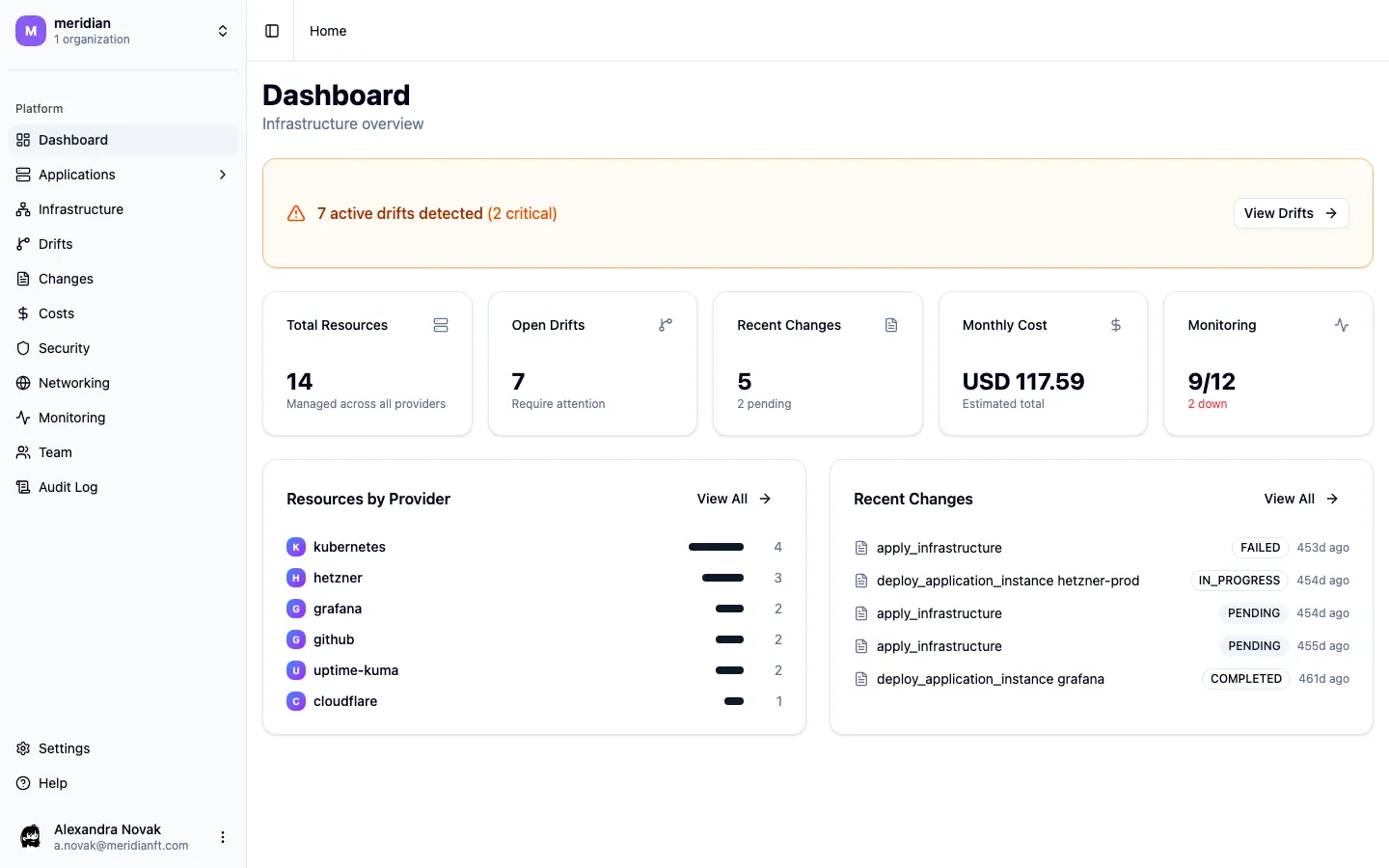
Unlike Terraform (which manages cloud resources through code) or Portainer (which manages containers), Infragnite manages everything your team runs: bare metal servers, cloud VMs, DNS, monitoring, CI/CD, analytics, reverse proxies, and the connections between them — all from one dashboard.
How It Fits Together
Section titled “How It Fits Together” ┌──────────────────────────────────────┐ │ You (Browser / API) │ └──────────────────┬───────────────────┘ │ ┌──────────────────▼───────────────────┐ │ Infragnite Control Plane │ │ │ │ Dashboard Drifts Changes Costs │ │ Security Team Audit Monitoring │ └──────────────────┬───────────────────┘ │ native APIs ┌──────┬───────┬────────┼────────┬───────┬───────┐ │ │ │ │ │ │ │ ┌─▼─┐ ┌─▼──┐ ┌──▼──┐ ┌──▼──┐ ┌──▼──┐ ┌─▼──┐ ┌─▼──┐ │DO │ │ Hz │ │ CF │ │ GH │ │ K8s │ │ GF │ │... │ └───┘ └────┘ └─────┘ └─────┘ └─────┘ └────┘ └────┘ Your infrastructure — runs with or without InfragniteInfragnite communicates with each provider through its native API. No agents, no sidecars, no custom runtime. If you stop using Infragnite, your infrastructure keeps running.
Core Principles
Section titled “Core Principles”Zero vendor lock-in. Infragnite orchestrates widely adopted, industry-standard tools — Kubernetes, Docker Compose, Grafana, Traefik, Cloudflare — rather than replacing them. If you stop using Infragnite, your infrastructure keeps running exactly as it is. We are a control plane layer, not a runtime dependency.
UI-first. No custom language or config files to learn. Visual diffs, approvals, cost dashboards, and team management — all in the browser.
Non-invasive. We use each provider’s native API. No agents on your servers, no sidecars in your containers, no custom runtime injected into your stack.
What You Can Manage
Section titled “What You Can Manage”Infragnite manages infrastructure through boosters — provider plugins that handle specific platforms:
| Provider | What It Manages |
|---|---|
| DigitalOcean | Apps, Databases, Droplets, Load Balancers, Domains |
| Hetzner | Dedicated servers, SSH keys, server provisioning |
| Cloudflare | DNS records, redirect rules, Workers |
| GitHub | Repositories, SSH keys, GitHub Apps, Actions runners |
| Kubernetes | Deployments, Services, ConfigMaps, Ingresses |
| Docker | Docker Compose deployments on remote hosts |
| Grafana | Dashboards, datasources, alerts |
| Uptime Kuma | HTTP/TCP monitors, status pages |
| Traefik | Reverse proxy, TLS certificates |
| Plausible | Analytics sites |
| n8n | Workflow automation |
| Auth0 | Applications, connections, rules |
| Tutanota | Email accounts and aliases |
| Windmill | Scripts, flows, schedules |
What Sets Infragnite Apart
Section titled “What Sets Infragnite Apart”| Terraform | Portainer | Cloud Consoles | Infragnite | |
|---|---|---|---|---|
| Interface | CLI (HCL) | Web UI | Web UI per provider | Unified Web UI + API |
| Scope | Cloud resources | Containers only | One provider at a time | 14 providers + bare metal |
| State | Must be managed | N/A | N/A | Cache — provider API is truth |
| Bare metal | No | No | Per provider | Yes |
| Monitoring | Not included | Not included | Per provider | Built-in (Grafana, Uptime Kuma) |
| Cost tracking | Third-party | No | Per provider | Unified |
| Vendor lock-in | HCL + state files | Management layer required | Per provider | Zero |
Next Steps
Section titled “Next Steps”- Key Concepts — organizations, workspaces, boosters, drifts, and roles
- How It Works — state philosophy, change flow, and the non-invasive model
- Who it’s for — target audiences and use cases
- Features — detailed feature overview with screenshots
- Deployment Options — cloud SaaS vs self-hosted